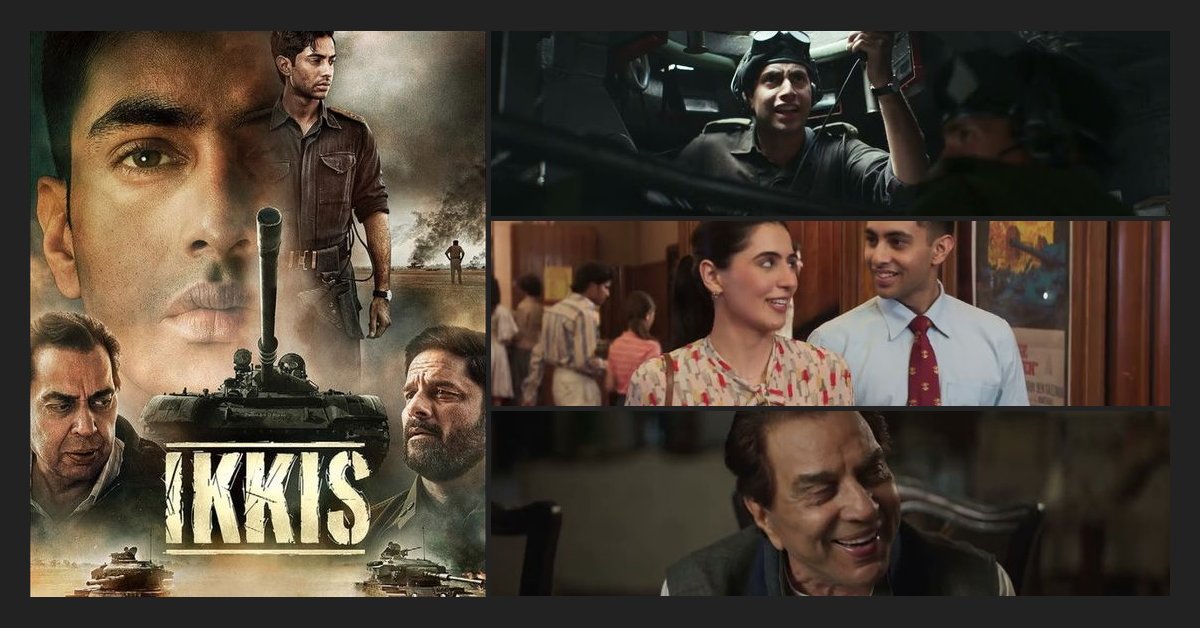

I just walked out of the theater and honestly, I'm sitting in my car trying to process it. My throat feels tight. 'Ikkis' isn't just a war film; it's a gut punch about legacy and loss. I keep thinking about that final shot of the father, standing alone in a place that was once home. It's 2026, and a movie made me think about the weight of history in a way I wasn't prepared for. I wasn't expecting to feel this quiet, reflective sadness. It's not the adrenaline of battle that's stuck with me, but the profound silence that comes after.
🎬 Watch the Official Trailer
What's Ikkis About?
The film tells the story of Arun Khetarpal, India's youngest Param Vir Chakra recipient, who died heroically at 21 in the 1971 Battle of Basantar. But the real hook is the parallel narrative, set 30 years later, following his aging father as he travels to post-partition Pakistan to visit his old home and school. It's a dual portrait—one of fiery, youthful sacrifice, and the other of a lifetime spent carrying that sacrifice.
What Works in Ikkis
- ✓ The father-son dynamic, shown through memory and absence, was heartbreakingly subtle. I felt the father's quiet pride more than any shouted dialogue.
- ✓ Jaideep Ahlawat as the older father was phenomenal. His entire performance was in his eyes—a masterclass in restrained grief.
- ✓ The battle sequences were chaotic and terrifying, not glorified. I actually flinched during the tank warfare; it felt brutally real.
- ✓ The script's refusal to be jingoistic. It questions the very nature of war and memory, which took guts for a film on this subject.
What Doesn't Work
- ✗ The pacing in the first act was a bit slow. I caught myself checking my watch before the narrative engine truly kicked in.
- ✗ Agastya Nanda, while sincere, sometimes felt a bit too clean-cut as Arun. I wanted more of the raw, scared boy beneath the officer's uniform.
- ✗ The 148-minute runtime is felt. A tighter edit, especially in the nostalgic flashbacks, would have increased the impact.
Standout Moments & Performances
Two scenes wrecked me. First, a simple moment where the father, in Pakistan, is offered tea by a local. The normalcy of the gesture against the backdrop of historic pain was incredibly powerful. Second, the cross-cutting between the son's final radio transmission and the father, decades later, listening to a static-filled recording of it. I had tears in my eyes. It connected their timelines in the most devastating way. Also, the tank battle in the mustard fields—the color, the noise, the confusion—it was pure cinematic chaos that left me breathless.
Main Cast: Dharmendra, Jaideep Ahlawat, Agastya Nanda, Simar Bhatia, Shree Bishnoi
Direction, Music & Visuals
Sriram Raghavan's direction is surprisingly lyrical for a war drama. The cinematography is stunning—the dusty, golden hues of Sargodha versus the cold, metallic grays of the battlefield. The sound design is a character itself; the whine of tank treads and the silence of empty rooms were equally loud. Music was used sparingly, which I appreciated. It let the performances breathe. Dharmendra, in his brief cameo, brought a gravity that anchored his scenes. But the film belongs to Jaideep Ahlawat. He says volumes without saying a word.
Director: Sriram Raghavan
Who Should Watch Ikkis?
This is for viewers who like their history complicated and their heroes human. If you enjoyed the reflective tone of a '1917' but wanted more emotional depth about the aftermath of loss, you'll connect with this. It's perfect for anyone interested in the personal stories behind our history books, and for those who don't mind a film that makes you think long after the credits roll.
Who Might Want to Skip?
If you're looking for a fast-paced, flag-waving, action-packed war epic, this isn't it. The drama is slow-burn and philosophical. Also, if you strongly prefer straightforward narratives, the dual-timeline structure might feel jarring.
Final Verdict
Would I recommend it? Absolutely, but with the caveat that you need to be in the right headspace. It's a demanding, emotionally draining film. It's not perfect—it meanders at times—but its heart is in the right place, and its message about the futility of war and the persistence of memory is profoundly moving. I wouldn't watch it again next week, but I know I'll think about it for a long time. It's a film that earns its sadness.